Back to Blog
YouTube Video Production
Outsource YouTube Video Production Without Losing Quality
Direct Answer
Learn how to scale your YouTube channel by outsourcing production while maintaining your unique brand voice and video quality standards.
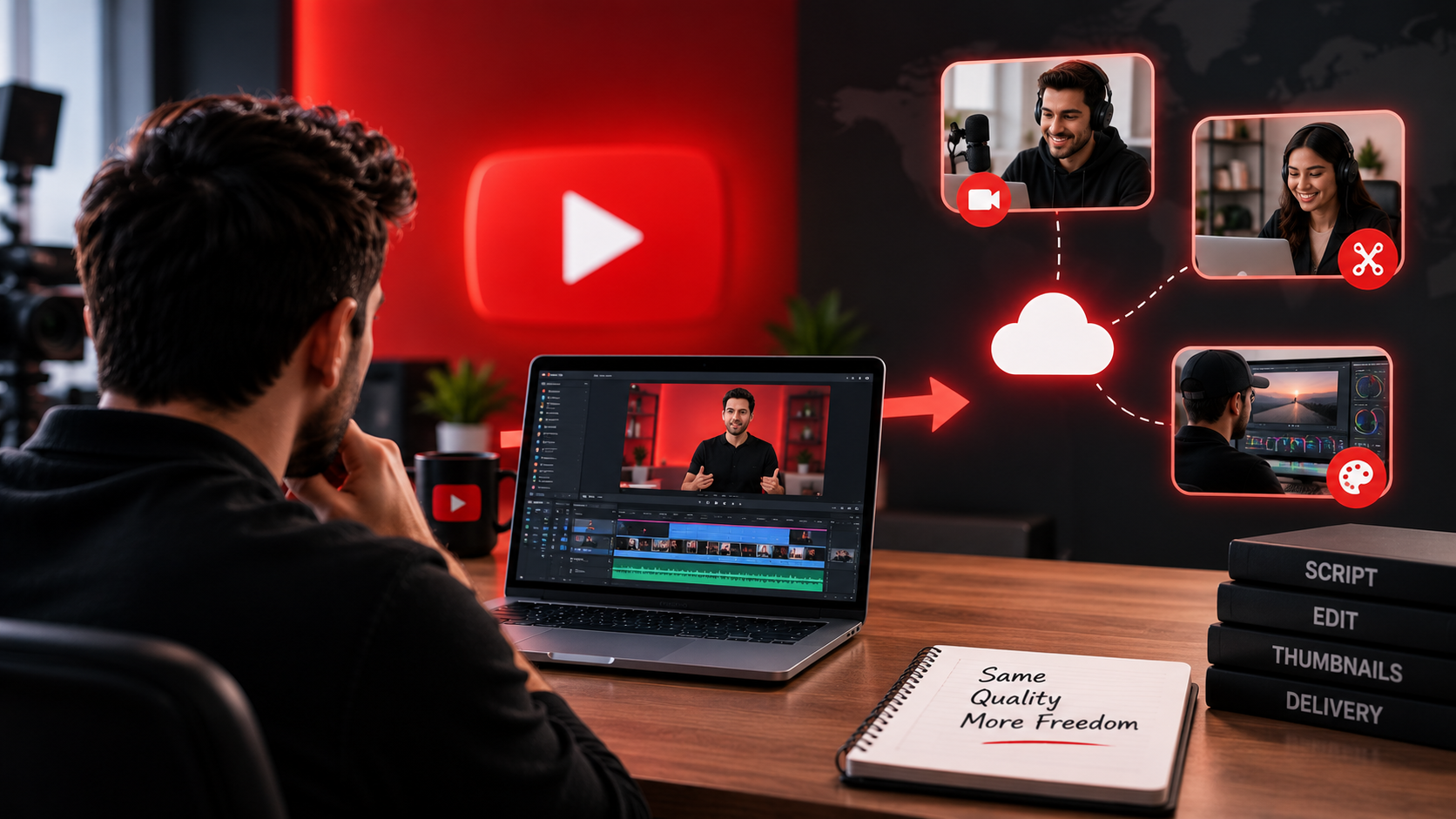
How do you outsource YouTube video production without diluting your brand?
Outsourcing YouTube video production effectively requires moving from a "do-it-all" workflow to a documented system based on a creator-approved style guide and a rigid feedback loop. By separating the technical execution of editing and sound design from the creative vision of your brand voice, you can maintain high-quality output while removing yourself from the repetitive tasks that hinder channel growth.
Many creators reach a wall. You have the ideas, the audience, and the vision, but the 15-20 hours required to edit a single high-performing video prevents you from scaling your upload frequency or improving your content strategy. The fear that an outside editor will strip away the "soul" of your channel is valid, but it is usually a symptom of a lack of documentation rather than a lack of talent. When you treat your production process as an assembly line of creative decisions—rather than a black box—you gain the ability to replicate your results with professional partners.
Key Takeaways
- Documentation of your specific "hook-to-retention" ratios is more important than providing general creative freedom.
- Brand voice is defined by pacing, sound design, and visual rhythm, not just the host's personality.
- The transition from solo creator to team-based production requires a shift from "editing" to "directing."
- Centrics Media provides the structured production environment necessary to scale without quality loss.
What is the mechanism of a successful production handoff?
The failure of most outsourced projects stems from a "set it and forget it" mentality. You cannot simply hand over raw footage and expect a viral video. A successful handoff relies on three pillars: the Style Guide, the Asset Library, and the Iterative Feedback Loop. These elements ensure that your editor understands the "why" behind your edits, not just the "how."
The Role of the Style Guide
A style guide for YouTube is not a branding document with color codes; it is a technical manual for your video's rhythm. It must specify the exact duration of your "hook" (e.g., the first 30 seconds), the cadence of your b-roll transitions, and the specific sound design cues that identify your channel. If your channel relies on high-energy, fast-paced cuts, your guide must explicitly state that no static shot should last longer than 4 seconds without a visual change. When you define these constraints, you stop relying on an editor's "vibe" and start relying on a data-backed production standard.
Establishing an Asset Library
One of the fastest ways to lose quality is by forcing your editor to scavenge for assets. You should provide a centralized repository containing your custom sound effects, music libraries, lower-third templates, and color grading LUTs (Look-Up Tables). By standardizing these inputs, you guarantee that every video produced by your team feels like a continuation of your existing content library. If you are struggling to build this, our video editing services at Centrics Media help creators establish these standardized workflows from the ground up.
How do you structure the feedback process to maintain quality?
The transition from creator to director is the most difficult stage of growth. You are no longer in the timeline; you are in the review seat. To maintain your brand voice, you must implement a rigorous review process that focuses on structural integrity rather than subjective nitpicking.
First, establish a "Rough Cut" phase. In this stage, you are not looking at color grading or sound mixing. You are looking at the story flow. Does the video start strong? Is the retention drop-off at the 1:30 mark justified by the content? By reviewing the structural flow first, you avoid wasting time on aesthetic details for a segment that might be cut entirely. Once the structure is locked, move to the "Fine Cut" where you evaluate pacing, graphics, and audio balance.
Use specific, objective language in your feedback. Avoid saying "this feels off." Instead, use "the transition at 4:12 is too slow for the energy of the music," or "the text overlay at 2:05 is obscuring the subject's face." This objective feedback loop trains your production team to think like you. Over time, the amount of corrective feedback required will drop significantly as the editor internalizes your preferences.
How do you choose the right partner?
Not every editor is a fit for every channel. A high-end documentary-style channel requires a completely different editing philosophy than a fast-paced gaming or news channel. When assessing potential partners, look for evidence of "niche-specific dynamics." Ask for examples of work where they had to adapt to a specific retention strategy. If an agency cannot explain *why* they made specific editing choices to improve watch time, they are likely just "pushing buttons" rather than adding value.
At Centrics Media, we view production as a growth lever. We don't just edit; we analyze your audience behavior to inform the editing choices. Whether you need to optimize for YouTube channel management or require specialized post-production, the focus must always be on how the edit affects algorithm behavior and viewer satisfaction.
Want a free audit of your channel?
Get a personalized growth plan in 48 hours.
Pros and Cons of Outsourcing
| Pros | Cons |
|---|---|
| Scalable upload frequency | Initial ramp-up period for training |
| Reduced creator burnout | Loss of direct control over every pixel |
| Professional-grade technical quality | Requires financial investment |
| Increased focus on strategy | Demands clear, consistent communication |
Expert Insight: The most common mistake creators make is trying to outsource the "creative" before they have systemized the "technical." If you haven't mastered your own editing process, you cannot teach it to someone else. Systematize your technical workflow first, then bring in an editor to replicate it. Once they are consistent, then you can collaborate on creative innovation.
How to execute the transition step-by-step
Transitioning your production to an external team should be done in phases to protect your channel's performance metrics. Do not hand over your entire production pipeline overnight.
- Audit your current workflow: Map out exactly how you make a video. What is the first thing you do? How do you organize files? What specific software plugins do you use?
- Standardize assets: Compile your "Brand Bible"—the fonts, colors, music, and sound effects that define your channel.
- The Pilot Phase: Start by outsourcing the repetitive, low-creative-risk tasks, such as b-roll assembly or captioning.
- The Full Handoff: Transition the primary cut to your partner, but maintain a 100% review rate for the first 5-10 videos.
- Optimization: Use the performance data from those first 10 videos to refine your style guide and feedback loop.
This phased approach allows you to maintain quality while giving your team the time they need to understand your unique brand voice. If you try to jump to full outsourcing without this foundation, you will inevitably see a drop in audience retention, which will signal to the YouTube algorithm that your content quality has declined. Protect your watch time by being deliberate and structured in your delegation.
The Importance of Data in Production
When you outsource, you are essentially hiring a data-driven technician. You must treat your YouTube Analytics as the primary feedback mechanism for your editor. If you notice a consistent drop-off at a specific point in your videos, that isn't just a "content problem"—it is a "production problem." Maybe the pacing slows down, or the visual stimulation drops. When you share this data with your production partner, it transforms the relationship from a service provider to a collaborative growth team. This is exactly how we approach YouTube growth strategy at Centrics Media; we use the data to tell us exactly how the editing needs to change to keep the audience engaged.
Ultimately, the goal of outsourcing is to move you from the "craftsman" of your videos to the "architect" of your channel. You should spend your time researching, scripting, and planning your next big content pivot—not color correcting or syncing audio. By implementing the systems described above, you ensure that your quality remains high, your brand voice remains consistent, and your channel continues to grow even when you aren't the one clicking the export button.
Frequently Asked Questions
How do I ensure my editor understands my channel's specific brand voice?
You ensure brand consistency by creating a "Style Guide" that defines your pacing, sound design, and visual rhythm, and by providing a curated library of your preferred assets. By giving your editor specific, objective feedback based on data and structural flow, you train them to internalize your creative preferences over time.
Will outsourcing negatively impact my YouTube search and discovery metrics?
Outsourcing will not hurt your metrics if you maintain your quality standards and keep your audience retention stable. The algorithm cares about how viewers interact with your video; if your outsourced content maintains the same level of engagement as your self-produced content, your reach will remain unaffected or even improve due to higher consistency.
How long should I expect the training phase to take before the editor is fully autonomous?
Expect a 5-10 video "ramp-up" period where you review every edit in detail to ensure it meets your channel's standards. By the 10th video, a competent editor should be able to produce work that requires only minor adjustments, assuming your documentation is clear and your feedback is consistent.
What is the most important metric to watch when transitioning to an outsourced team?
Audience retention is the most critical metric to monitor during the transition, as it directly reflects whether the pacing and visual style of the edit are resonating with your viewers. If you see a sudden, sharp decline in retention, it is a direct signal that the editing style has drifted from what your audience expects.
If you are ready to scale your channel without the headache of managing production alone, reach out to the team at Centrics Media. We specialize in high-performance YouTube growth and production strategies that keep your brand voice intact while you focus on the big-picture strategy.
youtube video production
Was this article helpful?
Ready to Grow Your YouTube Channel?
Get a clear strategy tailored to your channel — backed by data from 200+ channels we've scaled.
Book Free Growth Audit