Back to Blog
YouTube Video SEO
YouTube Video SEO: How to Rank for Buyer-Intent Keywords
Direct Answer
Learn how to optimize your YouTube metadata to capture high-value search traffic and convert viewers into customers with strategic SEO tactics.
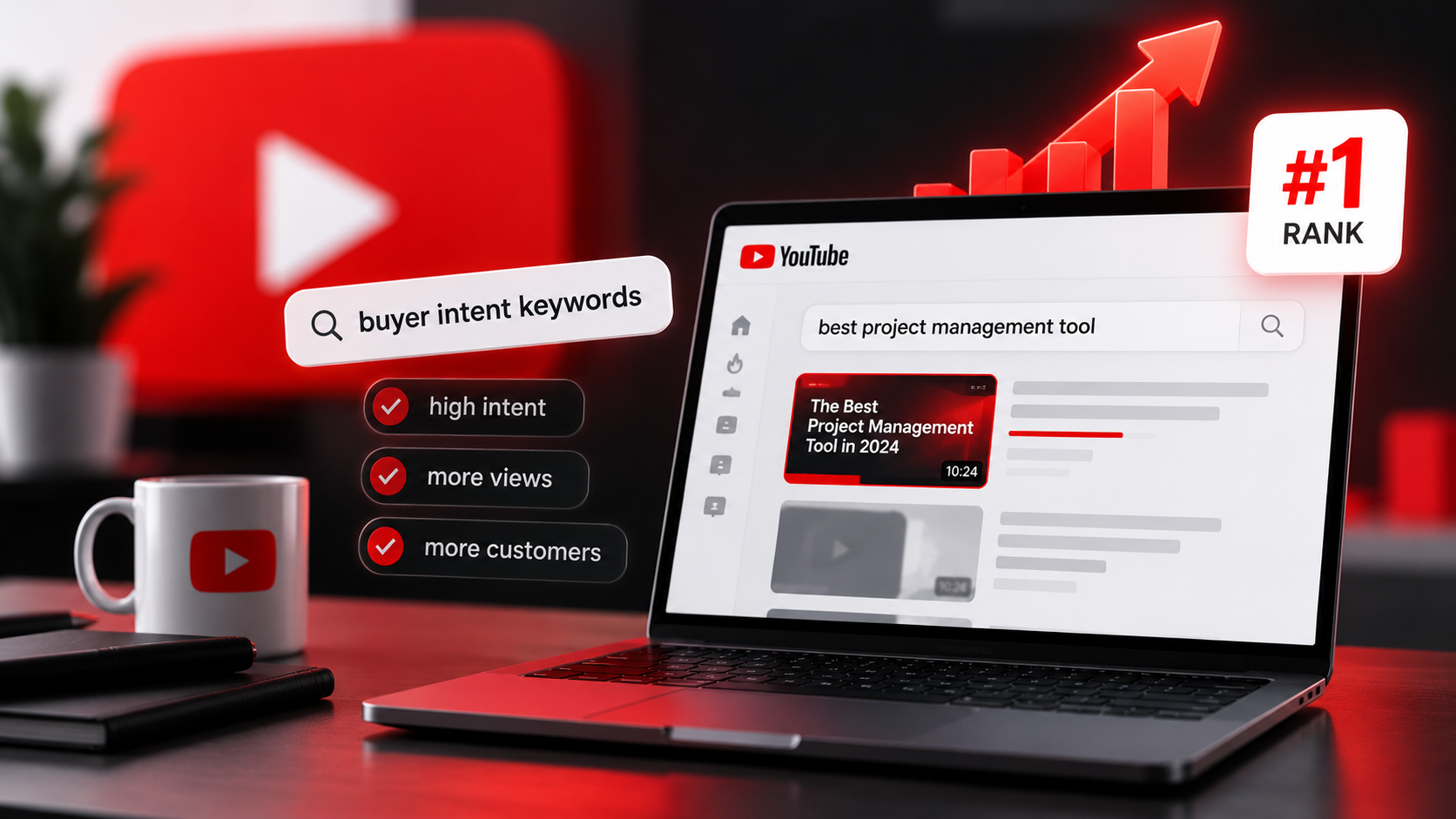
What is YouTube video SEO and how does it drive buyer intent?
YouTube video SEO is the process of optimizing your channel’s metadata, including titles, descriptions, tags, and closed captions, to align with specific user search queries and increase visibility in search results. By targeting buyer-intent keywords—phrases that indicate a user is looking for a solution, product, or service—you move beyond vanity metrics like raw views and instead attract an audience primed for conversion.
Most creators treat YouTube as a social feed. They focus on the 'browse' experience, hoping the algorithm picks up their video and serves it to a broad audience. That is a gamble. Relying on search intent is a strategy. When you optimize for search, you are not waiting for the algorithm to decide you are relevant; you are telling the platform exactly who your video is for and what problem it solves. This is the difference between a video that hits 10,000 views in a weekend and then dies, and a video that pulls in 500 targeted, high-value leads every single month for three years.
Why does search intent matter more than viral reach?
Viral reach is fickle. It relies on high Click-Through Rates (CTR) on broad topics that may or may not translate into revenue. Buyer-intent search traffic, however, is predictable. If someone types "best CRM for small business" into the YouTube search bar, they aren't looking for entertainment. They are looking for a tool to solve a specific pain point. If your video is optimized to rank for that query, you aren't just getting a view; you are getting a lead.
At Centrics Media, we see this shift constantly. Channels that pivot from "content for everyone" to "content for the searcher" see a massive increase in lead quality. When you optimize for buyer intent, your retention metrics tend to be higher because the audience is actively seeking the information you are providing. They don't click away at the 10-second mark; they watch to see if you have the solution they need.
Expert Insight: The "Problem-Agitate-Solve" Framework
When writing metadata for buyer-intent keywords, don't just list the keyword. Use the P-A-S framework in your description. State the problem (the keyword), agitate the pain (why it’s costing them money or time), and provide the solution (your video content). This structure naturally encourages the algorithm to index your video for the right audience while simultaneously convincing the viewer that your video is worth their time.
How does the YouTube algorithm process your metadata?
The YouTube algorithm doesn't "watch" your video to understand its content in the way a human does. It relies on text-based data—your title, description, transcript, and file name—to build a semantic map of what your video is about. When you upload a video, the system processes your metadata to determine the "topic clusters" your video belongs to.
If your title is "My Trip to Japan" but the content is about "How to use professional camera gear for travel vlogging," the algorithm will struggle to place you. It will show your video to people interested in travel, who will then bounce because they wanted a vlog, not a technical tutorial. This destroys your retention rate. Proper metadata alignment ensures the machine-learning models categorize your video accurately, which in turn leads to higher "suggested video" placements in your specific niche.
The role of closed captions in SEO
Many creators ignore closed captions, viewing them as an accessibility feature. They are actually a massive SEO asset. YouTube indexes the words spoken in your video. If you don't have a transcript or if you rely on the auto-generated captions, you are missing an opportunity to reinforce your target keywords. Uploading a custom SRT file or editing your transcript to include natural mentions of your primary and secondary keywords provides the algorithm with a literal script of your content, significantly increasing your chances of ranking for long-tail search terms.
How do you perform effective keyword research for YouTube?
You cannot guess what your audience is searching for. You need to use data. Start by looking at the search auto-complete feature in the YouTube search bar. Type in your core topic, like "digital marketing," and see what the platform suggests. These suggestions are based on real, high-volume search queries.
Once you have a list of potential queries, evaluate them for "buyer intent." A search for "free marketing tools" has lower intent than "best marketing software for mid-sized agencies." The latter shows that the user is closer to a purchase decision. You can use tools like Google Trends or dedicated YouTube keyword research suites to verify search volume, but never prioritize volume over relevance. A keyword with 500 monthly searches from people ready to buy is worth more than a keyword with 50,000 monthly searches from people looking for free entertainment.
Want a free audit of your channel?
Get a personalized growth plan in 48 hours.
Key Takeaways
- Focus on intent: Target keywords that signal a user is looking for a solution, not just general information.
- Metadata alignment: Ensure your title, description, and transcript all reinforce the same core keyword cluster.
- Retention is SEO: High search ranking is useless if your video doesn't keep viewers watching; use metadata to set expectations that your content delivers on.
- Leverage transcripts: Use your video transcript as a secondary layer of SEO by ensuring your primary keywords appear naturally in the spoken audio.
What are the common pitfalls in YouTube metadata optimization?
The most common mistake is keyword stuffing. Adding a list of 50 keywords to your description is not optimization; it is spam. The algorithm is sophisticated enough to penalize this behavior. Your description should be a coherent summary of your video, written for a human reader, that happens to include your keywords naturally.
Another pitfall is ignoring the "first two lines" rule. When your video appears in search results, the viewer only sees the first two lines of your description. If you don't put your primary keyword and a strong value proposition in those first 150 characters, you are losing potential clicks. If you need help refining these strategies, our YouTube channel management services are designed to audit and optimize these exact touchpoints for growth.
How do you track the success of your SEO efforts?
Success in search-based SEO isn't measured by overnight spikes. It is measured by the "Search" traffic source in your YouTube Analytics. Look at your "Traffic Source: YouTube Search" report. Are you ranking for your target keywords? Is your CTR from search results higher than your overall channel average? If your CTR is low, your title or thumbnail isn't matching the user's intent, even if the algorithm is successfully placing you in the results.
If you see high rankings but low retention, your metadata is doing its job, but your content isn't satisfying the searcher. You need to adjust the video structure to address the user's query immediately. At Centrics Media, we often find that creators lose viewers because they spend the first minute on an intro that the searcher doesn't care about. Get straight to the point.
| Metric | Social/Browse Strategy | Search/Intent Strategy |
|---|---|---|
| Primary Goal | Broad reach/Virality | Targeted lead acquisition |
| Traffic Source | Home feed/Suggested | YouTube Search |
| Content Longevity | Short-term | Evergreen |
| Ideal Viewer | General audience | Buyer-intent searcher |
Why should you consider professional optimization?
YouTube SEO is a moving target. The algorithm changes, search behaviors shift, and the competition for high-value keywords is constantly increasing. Attempting to manage this while also producing, editing, and distributing content is rarely sustainable. Our team at Centrics Media focuses on the technical nuances—the metadata, the indexing, and the search alignment—so you can focus on the creative side of your business. We provide the YouTube video SEO and metadata optimization services necessary to move your channel from a hobby into a predictable lead-generation machine.
Frequently Asked Questions
How long does it take for YouTube SEO changes to show results?
While some changes can impact rankings within 48 to 72 hours, true search authority for competitive keywords typically builds over 30 to 90 days as the algorithm re-indexes your content and gathers sufficient retention data.
Does changing the title of an old video hurt its performance?
Updating an old title to better align with search intent can significantly improve performance, provided the new title is still accurate to the video content and doesn't trigger a "clickbait" penalty by misleading viewers.
How many keywords should I include in my video description?
Focus on one primary keyword and 2-3 secondary, long-tail variations that naturally fit into a 200-300 word description; avoid listing keywords in a block at the bottom of the description.
Is there a specific length for a video to rank better in search?
There is no "magic" length for SEO, but videos that are long enough to thoroughly answer the user's query—typically 8 to 15 minutes—tend to perform better because they naturally capture more watch time and retention.
If you are ready to stop guessing and start ranking, let’s talk. Our team specializes in the technical heavy lifting that transforms your video library into an asset that works for you 24/7. Reach out to Centrics Media today to see how we can optimize your channel for real growth.
youtube video optimization
Was this article helpful?
Ready to Grow Your YouTube Channel?
Get a clear strategy tailored to your channel — backed by data from 200+ channels we've scaled.
Book Free Growth Audit